
Rules, AI and people. Working as one.
We design business workflows that combine deterministic logic, AI capabilities and human review. Evidence checks, permissions and approval gates define what can run automatically and what needs a decision.
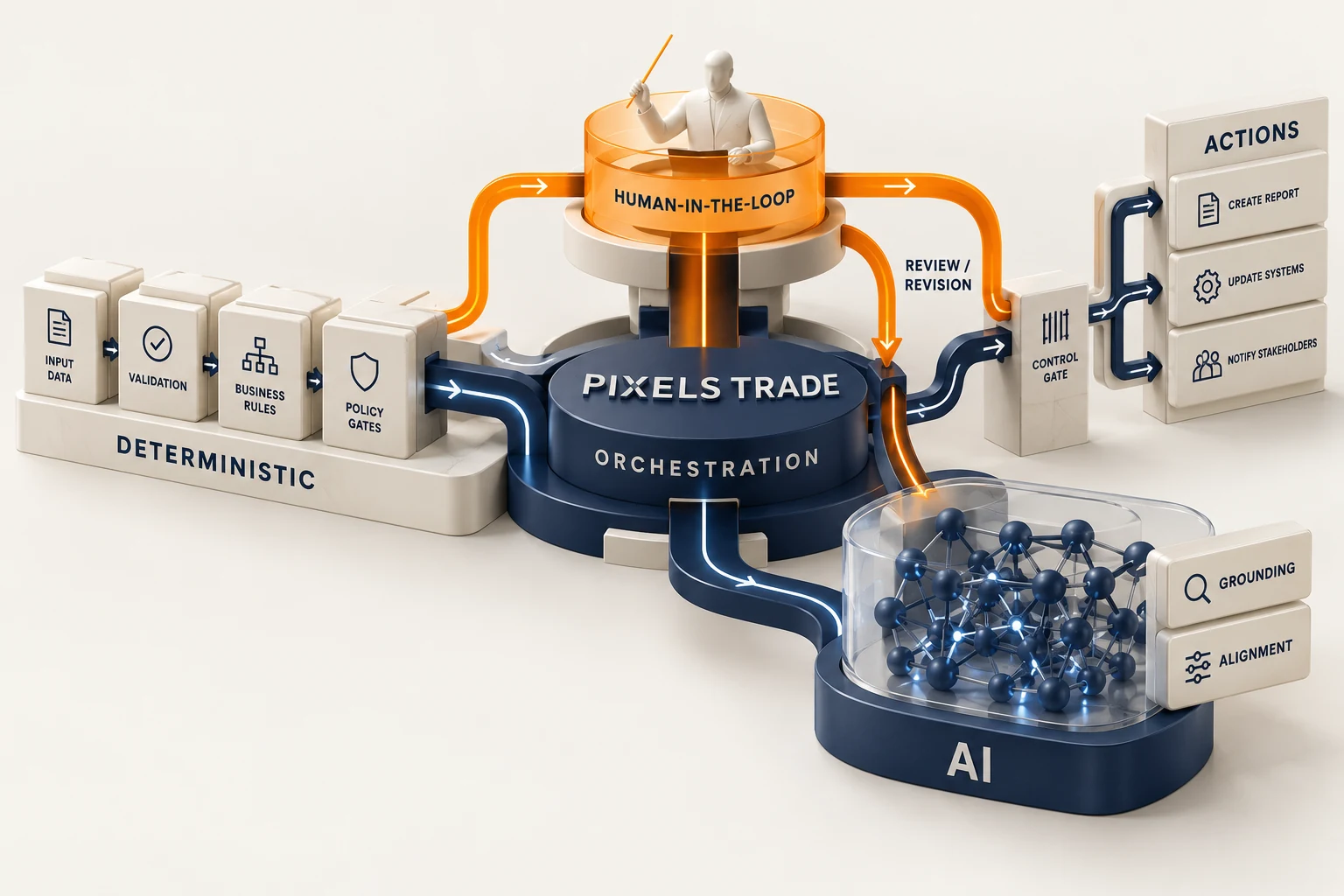
The workflow is the product of the orchestration.
Pixels Trade organises the process across CRM, ERP, document stores and operational tools. The value lies in defining the steps, the controls and the people accountable for the result.
Handoffs
Where do people repeat work across systems or wait for missing information?
Authority
What may an agent propose, and what may the execution system actually do?
Exceptions
How does the process stop, recover or reach a responsible reviewer?
Capabilities shaped around your use.

Workflow automation
Connect CRM, ERP, service desks, document stores and reporting tools using n8n, Make or custom code, according to data and operating constraints.
Controlled AI steps
Use AI for classification, extraction, summarisation and drafting. Give agents scoped tools, permissions, action budgets and escalation paths.
Human-in-the-loop decisions
Bind approval to the exact action, parameters and evidence. Sensitive actions wait for an authorised reviewer; rejection produces no business effect.
Reliable execution
Keep enforcement outside the LLM. Design idempotency, retries, timeouts, logs and failure handling, with compensating actions where rollback is unavailable.
A proposal is not permission to act.
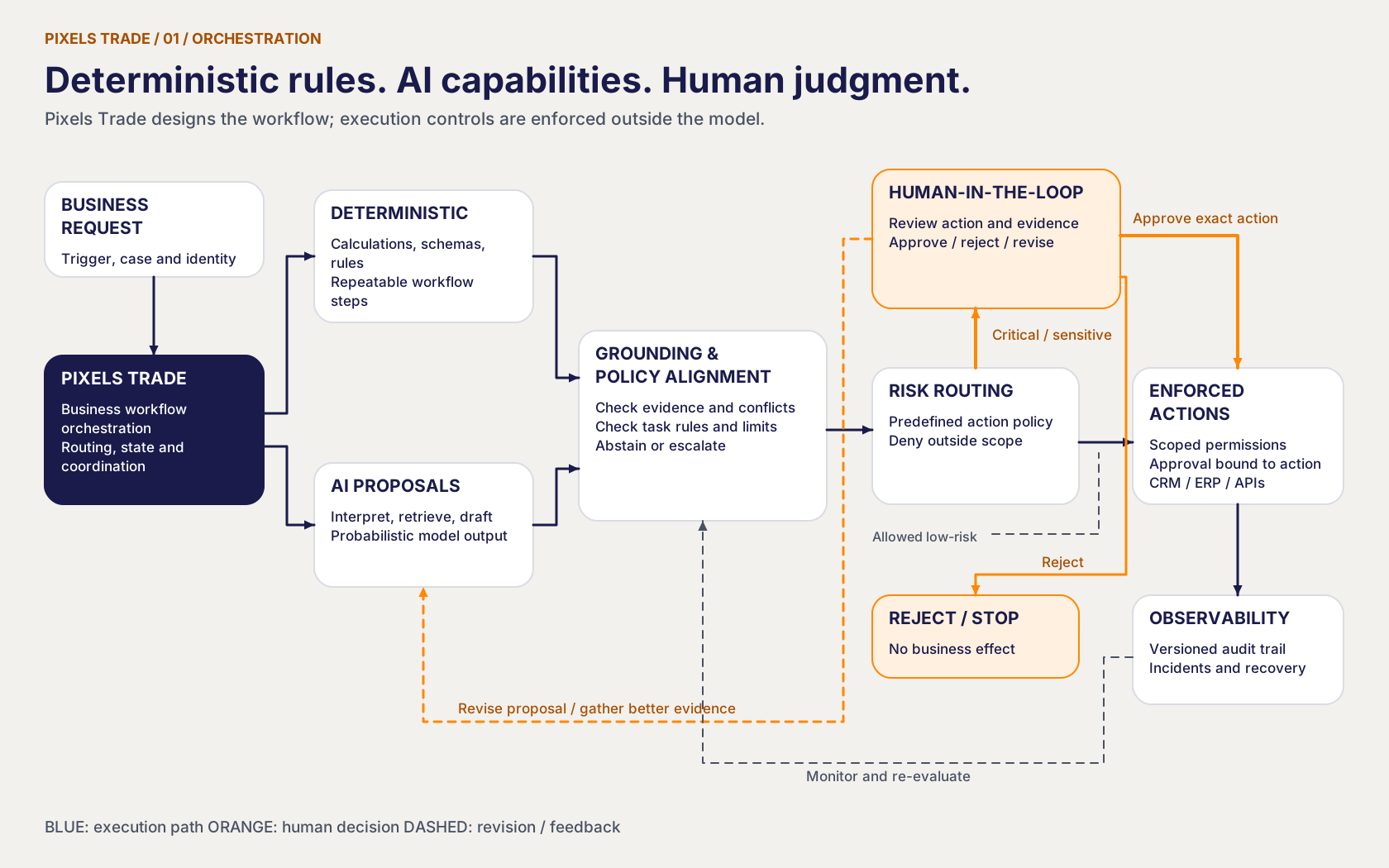
Map the business request
Identify the user, task, business rules, systems and permitted actions. The Pixels Trade orchestration layer coordinates the workflow.
Use the right engine
Deterministic logic enforces defined rules. AI proposes or interprets where useful; it does not replace the execution authority.
Check evidence and policy
Grounding examines supporting evidence. Policy alignment evaluates behaviour against defined instructions and business constraints. Permissions and risk determine the next route.
Approve the exact action
An authorised human can approve, reject or request revision. Approval is bound to the reviewed action and parameters; a changed proposal needs a new decision.
Execute and observe
The execution system rechecks authority, logs the outcome and handles errors. Low-impact actions can follow a predefined policy; sensitive actions remain blocked until approved.
Grounding, policy alignment and human review address different risks. They must be evaluated on the real use case and do not guarantee freedom from errors. Human-in-the-loop (HITL) is the validation term used here.
Deliverables you can use.
Process map
A selected workflow, baseline, business owner and measurable outcome.
Control specification
Permissions, approval binding, evidence requirements, exceptions and failure paths.
Operating workflow
Integrations, execution logs, monitoring and handover to the process owner.
A clear route from assumptions to evidence.
Map
Describe handoffs, decisions and the intended business effect.
Design controls
Separate proposals, approvals and deterministic enforcement.
Test
Exercise normal, refusal, changed-action and failure paths.
Run & improve
Monitor outcomes, exceptions and controls with the accountable team.
Agents & Automation, answered
n8n, Make or custom code?
We compare governance, connectors, hosting options, cost, maintainability and team skills for the workflow. These tools support implementation; they do not replace the process and control design.
Do all actions need human approval?
No. Approval is proportionate to risk. Reversible low-impact actions can follow an approved automation policy; consequential actions need controls appropriate to the business context.
Can the AI bypass a refusal?
The workflow must enforce authorisation outside the model. A refusal blocks the reviewed action. A revised proposal or changed parameters require a new decision.
Is orchestration the same as platform development?
No. Orchestration organises work across people, algorithms, AI and existing systems. New applications or APIs can support it where integration requires them.

Start with your use case.
Bring the workflow, the constraints and the decision you need to make. Together we can define a useful next step and the evidence it should produce.