
Explore the architecture. Understand its limits.
Train a small neural network, inspect source retrieval, test a human approval path and estimate model memory. See which parts calculate real results and which illustrate a design decision.
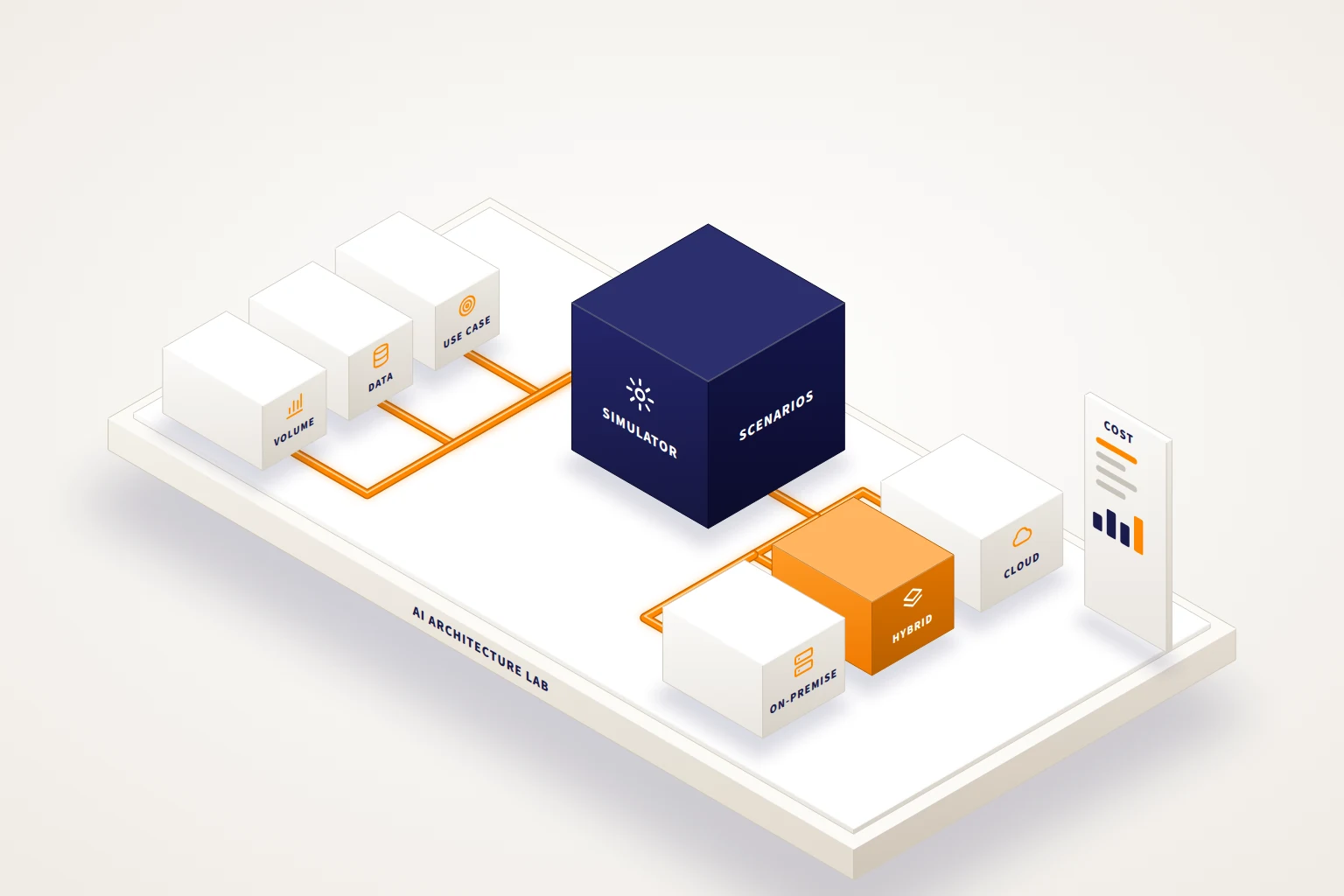
Four experiments. Clear scope.
The lab runs educational examples with synthetic data in your browser. It does not connect to a production LLM, external business system or clinical data.
Learn
Change assumptions and observe the resulting behaviour.
Inspect
Read the calculation method and the limits of each experiment.
Apply
Use the questions raised by the lab to frame a real project.
Real calculations and clearly labelled simulations.

Real small neural network
A fully connected MLP performs actual forward passes, backpropagation and mini-batch gradient updates on synthetic two-dimensional classification data.
Lexical retrieval
BM25 ranks a synthetic document corpus. Source permissions and freshness are example rules; displayed responses are source extracts, not generated LLM answers.
Simulated human approval
A local state machine illustrates approval, rejection and blocked actions. It cannot authorise or modify any external system.
Memory estimates
Nominal weight and full KV-cache formulas expose hardware assumptions. They are estimates, not measured throughput, latency or a complete deployment sizing exercise.
Your local architecture playground.
Start with the neural network, then explore retrieval, approval and memory assumptions.
For a wider workspace, use the full-page lab link. Results belong to the stated synthetic experiment and must not be used as production or sector performance claims.
Know what is actually calculated.
Neural network
A fully connected MLP uses selectable hidden activations and mini-batch SGD. The default 2–4–2–1 network has 25 trainable weights and biases. Displayed loss is mean half-squared error. The 500 synthetic points are split into training and test sets; tuning repeatedly against the test set requires a separate final holdout.
Retrieval & approvals
BM25 uses k1 = 1.2 and b = 0.75. Relevance metrics apply only to the supplied example question with declared ground truth; a BM25 score is not a confidence probability. Freshness uses the fixed reference date 14 October 2026. Human approval changes local example state only.
Memory estimate
Nominal weights are parameters × bits / 8. Full KV-cache size uses layers, KV heads, head dimension, context length and concurrent sequences. The estimate adds an explicit runtime allowance; it does not measure quantisation overhead, multi-device distribution or serving performance.
The neural arithmetic derives from TensorFlow Playground under the Apache 2.0 licence, with attribution in the module. This lab is an independent Pixels Trade adaptation, not a claim of endorsement.
A practical basis for the next decision.
Questions for your project
Which tasks, sources, permissions and decision paths need evaluation?
Architecture boundaries
Separate model computation, retrieval, authorisation and operating responsibilities.
A route to validation
Define representative data, acceptance criteria and production controls with the responsible team.
A clear route from assumptions to evidence.
Experiment
Adjust one assumption at a time and observe the result.
Inspect limits
Distinguish measured local calculations from illustrative scenarios.
Map your use
Identify the data, risks, permissions and operating constraints that differ.
Validate
Build a task-specific protocol before making a production decision.
AI Architecture Lab, answered
Is this a production LLM benchmark?
No. The neural experiment trains a small MLP on synthetic two-dimensional data. It does not measure the capabilities of a transformer or production LLM.
Does the RAG experiment generate answers with an LLM?
No. It uses real lexical BM25 ranking over a synthetic corpus and displays source extracts. It does not call a language model or live Internet search.
Are the approval controls production security?
No. The approval example is a local state-machine simulation. Production identity, server-side authorisation, secrets and exact-action enforcement must be designed and verified separately.
Can the lab predict clinical, banking or regulatory outcomes?
No. Sector examples are synthetic educational fixtures. They are not clinical predictors, financial decisions, compliance scores or evidence of certification.

Start with your use case.
Bring the workflow, the constraints and the decision you need to make. Together we can define a useful next step and the evidence it should produce.