
Your knowledge. A governed view of the world.
We combine indexed internal knowledge with approved external sources when the use case requires it. Access rights, freshness and provenance shape retrieval; grounding checks distinguish supporting evidence from model inference.

Retrieval should make evidence usable.
The source strategy, indexing quality and evaluation determine whether retrieved context helps. We make the scope of knowledge visible instead of presenting every model answer as a verified fact.
Access
Can users retrieve only the information they are authorised to see?
Coverage
Are internal sources sufficient, current and relevant for the question?
Evidence
Can a reader trace a claim to the source that actually supports it?
Capabilities shaped around your use.

Reliable ingestion
Connect documents and business systems. Handle OCR, structure, metadata, versions, deletions and synchronisation failures.
Retrieval that fits the content
Evaluate keyword, vector and hybrid search, chunking and reranking. Apply user permissions before information enters the model context.
Answers users can verify
Provide source references, distinguish evidence from inference and support abstention when sources are missing, stale or inconsistent.
Governed external retrieval
When authorised, add curated external sources or search tools. Keep origin, freshness, trust level and conflicts visible, separate from internal authority.
Internal authority. External context. Explicit controls.
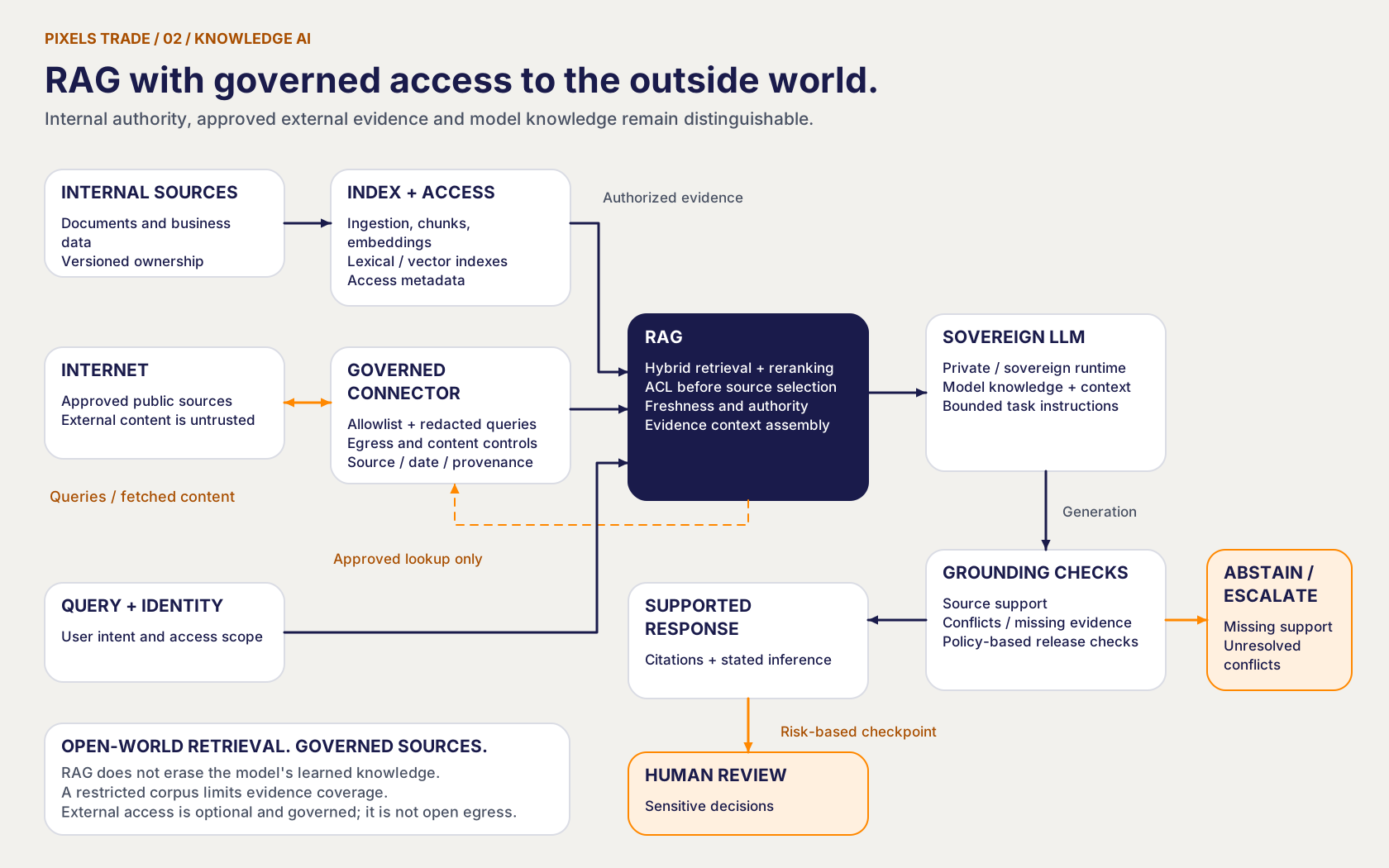
Start with identity and scope
The request carries the user’s permissions and the source policy. Document access is enforced before retrieval.
Choose evidence sources
The internal index is authoritative where defined. Optional Internet retrieval uses approved sources, query redaction and an egress boundary.
Retrieve and inspect
Lexical or vector search and reranking select passages; freshness, provenance and conflicting evidence remain visible.
Ground and route the response
The model uses the selected context. Unsupported claims, missing evidence or sensitive decisions trigger abstention or human review; retrieved content is treated as untrusted data.
RAG does not erase a model’s learned knowledge, and indexing is not weight training. A limited corpus can leave gaps in evidence or freshness. External retrieval can help, with additional latency, cost and security risks; it does not guarantee completeness or accuracy.
Deliverables you can use.
Source & permissions map
Authoritative sources, approved external scope, access rules, freshness and deletion procedures.
Retrieval evaluation
Representative questions covering relevance, coverage, provenance and access leakage.
Knowledge assistant
An agreed source-referenced experience, feedback mechanism and quality monitoring plan.
A clear route from assumptions to evidence.
Map sources
Define authority, ownership, access and update rules.
Build retrieval
Implement ingestion, indexing and the permitted external boundary.
Evaluate
Test retrieval relevance, evidence support and failure behaviour.
Operate
Track source changes, feedback, quality and access controls.
Knowledge AI & RAG, answered
Does RAG eliminate hallucinations?
No. It can improve grounding, but retrieval failures, misleading sources and unsupported generation remain possible. We evaluate these failure modes and define appropriate controls.
Is RAG the same as fine-tuning?
No. RAG retrieves information at inference time. Fine-tuning adapts model behaviour through training; it is not a dependable mechanism for keeping factual knowledge current.
Will internal documents limit the model to a closed world?
The model retains its learned capabilities. The application can also use approved external sources, depending on the data policy. We make the scope of evidence explicit.
Does RAG prevent prompt injection?
No. Retrieved content must be treated as untrusted data. Source controls, instruction separation, scoped tools and validation are still required.

Start with your use case.
Bring the workflow, the constraints and the decision you need to make. Together we can define a useful next step and the evidence it should produce.